My Ancestors

Amanuesis Monday – Affidavit from Amos Conner

Amanuesis Monday is a daily blogging prompt from geneabloggerstribe.com which encourages the family historian to transcribe family letters, journals, audiotapes, and other historical artifacts. Amanuensis Monday is a popular ongoing series created by John Newmark at Transylvania Dutch.
2015-03-10 11-32

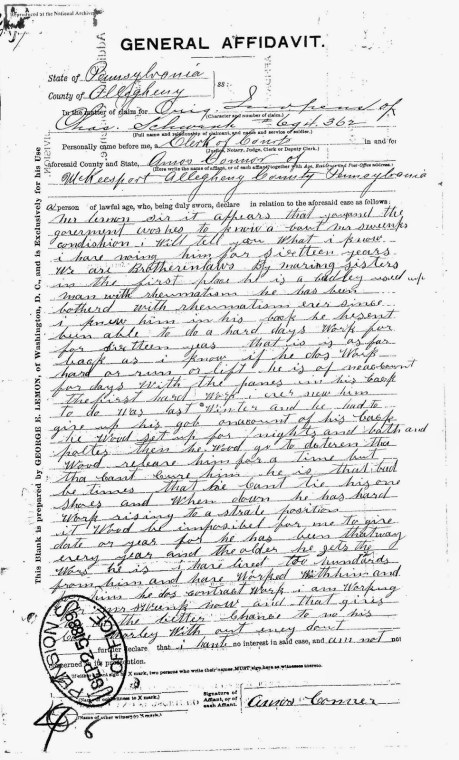
General Affidavit 
State of Pennsylvania
County of Allegheny
In the matter of claim for Orig. ? of Chas. Schwank #694362

Personally came before me Clerk of Court in and for aforesaid County and State, Amos Conner of McKeesport Allegheny County Pennsylvania. a person of lawful age, who, being duly sworn, declare in relation to the aforesaid case as follows:

Mr lemon sir is appears that you and the government wishes to know a bout mr swenks condishion. i will tell you what i know – i have noing him for sixteen years. We are brotherinlaws By maring sisters in the first place he is a badley used up man with rheumatism he has been botherd with rheumatism ever since i know him in his back he hesent been able to do a hard days work for sixteen years  that is as far back as i know if he dos work hard or run or lift he is of [?] for days with the panes in his back the first hard work i ever new him to do was last winter and he had to give up his job on acount of his back  he wood set up for nights and bath and saltes then he wood go to [?] this wood releave him for a time but that\ cant cure him  he is that bad be times that he cant tie his own shoes and when down he has hard work rising to a strate position  it wood be imposibel for me to give date or year for he has been that way every year and the older he gets the wors he is  i have lived too hundreds from him and have worked with him and for him  he dos contract work i am working for mr swenk now and that gives me all the better chance to no his case thorley with out eney dout.

Further declare that i havnt no interest in said case, and am not concerned for its protection.

                                                                                          [Amos Conner]

Sworn and subscribed 17 September 1889.

                                                                                          [DK. McGunnegle]
                                                                                          [Clerk of Courts]

This record is from the Civil War pension file of my second great-grandfather, Charles G. Schwenk.[1] Charles lived in Braddock, a steel town east of Pittsburgh, and filed a Declaration for Original Invalid Pension on 1 March 1889. His application stated that he had contracted rheumatism in his back from exposure, and that he incurred a “rupture” on his right site from wearing a cartridge box. This affidavit was submitted a few months later to support his case.

Charles was suffering from two chronic conditions. Rheumatism, inflammation and pain in the joints, was common in Civil War soldier, possibly caused by acute rheumatic fever.[2] His “rupture” was a hernia caused by wearing a cartridge box on his right side.

Amos Conner was Charles’ brother-in-law – his  wife Jane “Jennie” Burd was the sister of Charles’ wife Marian Burd. This particular affidavit was to be a statement of Charles’ current health struggles, as a result of his war injuries (there are other affidavits were about the injury itself).

“he is a badley used up man”

“hesent been able to do a hard days work for sixteen years”

“had to give up his job on acount of his back”

“times that he cant tie his own shoes”

Amos’ statement gave a clear picture of how much the rheumatism had affected Charles’ life and ability to work. Charles was recorded as a “laborer” after the war, and Amos stated that Charles did “contract work” indicating that he did not have a steady job. It’s hard to imagine Charles, and the vast number of veterans, trying to work manual labor with the injuries sustained in battle.

Charles’s pension packet had similar affidavits from friends and neighbors. He received an “Invalid Pension” of $8 a month for his hernia, and nothing for the rheumatism.[3] A year later he requested an increase to $16 for the continued back pain—his rate was increased to $10 a month.[4] Charles had a wife and four children under 16.

Charles’ pension file, over 85 pages, contains valuable information about his service, his life and physical struggles after the war, and his family. I will post more of my finds from Charles’ pension records … records that tell about the life of Charles Schwenk, as well as the new information that I found in the packet.

Do you have any Union Civil War ancestors? Have you looked for any pension files to see what you might find?


SOURCES:

[1] Affidavit of Amos Conner, 17 September 1889, Charles G. Schwenk (Pvt. Co. A and 1st Sgt. Co. C, 82nd Pennsylvania Inf., Civil War), pension application no. 694362, certificate no. 454879, Case Files of Approved Pension Applications … 1861-1934; Civil War and Later Pension Files; Department of Veterans Affairs, Record Group 15; National Archives, Washington, D.C.

[2] Bollet, Alfred Jay. “Rheumatic Diseases Among Civil War Troops.” Arthritis & Rheumatism 34.9 (1991): 1197–1203, (https://onlinelibrary.wiley.com/doi/pdf/10.1002/art.1780340919 : accessed 24 October 2018).

[3] Ibid., Surgeon’s Certificate for Charles G. “Swank,” 26 June 1889.

[4] Ibid., Declaration for Increase of Invalid Pension, Charles G. “Swank,” 15 September 1890.

© 2018 LAURA CUBBAGE-DRAPER. ALL RIGHTS RESERVED.

Women’s Words Wednesday – Sarah’s Will

So much of our history is recorded, remembered, and influenced by the views our male ancestors. But that’s only part of our story, and I am fascinated by the stories of our female ancestors. I am adding a new blogging category called Women’s Words Wednesday where I will post and reflect on these important words that I have found in my research, in whatever form they arise (letter, photo, official document, etc.).

Sarah (LNU) Cubbage is my 4th great-grandmother. Her husband William died intestate around 1820. Sarah died a few years later, around 1822, but unlike her husband, she did leave a will.[1]

Sarah Will 1Sarah Will 2

I Sarah Cubbage, widow of the late Wm Cubbage Decd of Pine Township Allegheny County State of Pennsylvania, do make this my last wil and Testament as follows, to wit, To my eldest daughter Martha Fletcher I do wil and bequeath on dollar, and to her eldest son known by the name of Samuel Cubbage, I do wil and bequeath one hundred-dollars to be paid to him out of my share of the estate of my husband Wm, Decd. The remaining part of my property I do allow to be equally divided between my sons, John George & Wm Cubbag and daughters Sarah Whitsell, Elizabeth Good, Mary Whitsell, & Jane deer. Except my clothing which I do allow to be divided amongst my daughters over and above their foregoing shares as follows to wit to my daughter Sarah Whitsell I do bequeath my black-silk shawl, provided her or her husband calls on it, to my daughter Elizabeth Good two of my Goats, to My daughter Mary Whitsell and Jane Deer I allow to be equally divided between them, except my spinning-wheel I allow to Jane and my son William’s eldest daughter I do bequeath a two-year-old heipher. And further I do appoint James Hilands Esq of Ross Township and George Whitsell of Pine Township to be my Executors, In witness whereof I have here unto set my hand and seal this thirteenth day of September in the year of our Lord one thousand Eight hundred and twenty two in the presence of

James Hilands                                                                                Sarah Cubbage                                     James McElwain                                                                            X her mark

[Sarah’s will was filed on 27 September 1822.]

I have not found many wills for my female ancestors, especially back as far as the early 1800s. There were estate proceedings found in the Orphan’s Court for her husband William, that continued even after she died. Much of those proceedings had to do with the division of his property to his heirs, including three children who moved west to Ohio and Kentucky. I wonder if Sarah decided to write out a will, or if she was influenced by her family, or if she saw what may have been happening with the division of property.

It is interesting that she left her oldest daughter Martha only one dollar, but to Martha’s oldest son she left one hundred dollars. I have seen other wills in Allegheny County where money was bequeathed to the oldest grandson. Martha had moved to Ohio before William had died, and I have not been able to locate her husband Joseph Fletcher. Sarah names her grandson as “Known by the name of Samuel Cubbage.” which may help in locating the Fletchers.

The rest of Sarah’s property was to be divided among the remaining seven children, with the exception of the special gifts of clothing, spinning wheel and goats that she left to her daughters that also lived in Pine Township. Sarah also left a heifer to the daughter of her son William, who was living in Pittsburgh.

Sarah’s words through her will (that was actually written on paper by another, her mark X indicating that she could not write), helps me to understand her relationship with her children. Rather than having her property divided equally, she had felt it was important enough to specify which items were to go to her children, especially her daughters. I wonder if she saw how the children handled her husband’s estate, and she wanted to be sure her wishes were carried out? Or if there was another reason that she made out a will before she died.

I am thankful to have Sarah’s words and wishes, expressed through her will, to know more about her and her family.


SOURCES:

[1] “Pennsylvania Probate Records, 1683-1994,” digital images, Family Search  (https://familysearch.org : 4 January 2018), Allegheny County, Wills 1808-1830, vol. 2, page 289, no. 221, Sarah Cubbage (1822).

© 2018 LAURA CUBBAGE-DRAPER. ALL RIGHTS RESERVED.

Throwback Thursday – Pittsburgh!

A year ago this week, I spent a some time in Pittsburgh – doing some of my favorite things in one of my favorite cities! It was a wonderful week of research, conference learning, tours and genealogy friends.

I originally started planning this trip when a genea-friend told me that that the Czechoslovak Genealogical Society International Annual Conference was being held in Pittsburgh. I had never attended a CGSI event, but it was a good place to attend one. My husband is mostly Slovak (three of his four grandparents are from Slovakia) and his mother was born in Slovakia before immigrating when she was a little over a year old. I attended two days of the conference and attended some excellent sessions on Slovak land records, Czecho-Slovak history, the Slovak language and more.

The conference offered several tours earlier in the week, and my friend and I attended the “Pittsburgh’s Industry of Our Immigrants” tour on Tuesday. I was very excited for this tour, not for the Slovak focus but because it included places that my father’s ancestors would have worked. We went to the Rivers of Steel National Heritage Area in Homestead during the morning, stopped at Penn Brewery on the North Side for lunch, and ended with a coal mine tour in Tarentum.

IMG_5808
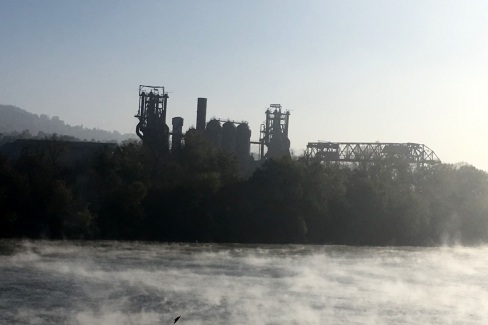
It was a cold morning and the fog on the Monongahela River added an eerie effect to the silhouette of Carrie Furnace.

The highlight of this day for me was the tour at Rivers of Steel, especially the guided tour at Carrie Furnace in Rankin, which had been a part of the Homestead Steel Works. My great grandfather, Charles Cubbage, worked in the blast furnace at Carrie when they lived in Swissvale in the early 1900s. It was an excellent tour where we were able to go into the furnace and learn about the iron making process. I always find it extremely moving to stand in the places where my ancestors stood. And to experience the massive size of Carrie was very powerful (luckily minus insane heat of the furnace). Our tour guide, Susie, was outstanding! If you are in the Pittsburgh area, I highly recommend this tour.

IMG_5817
The people in the foreground show the scale of Carrie Furnace.

On Wednesday, I spent some time at Homewood Cemetery in the Point Breeze neighborhood. Homewood is an almost 200-acre cemetery which is absolutely beautiful and well-maintained. I had emailed the cemetery ahead of time inquiring about record availability. A wonderful research volunteer, Richard, pulled records for my Cubbage ancestors and had copies of burial books, headstones, plot records, and other cemetery records for me. He even took me around to the locations of the graves (sadly, many of my ancestors didn’t have any tombstones).

IMG_5842

I went back to cemetery after lunch for a wonderful tour led by Jennie Benford. I had read about the tour through a link to a newspaper article on Homewood’s Facebook page. The tour, “Audacious Pioneers: The Women of Section 14”, was about a handful of women who were laid to rest in the section of the cemetery where some of Pittsburgh’s wealthiest were buried. Walking through this section, we saw amazing mausoleums, obelisks and headstones for names like Mellon, Heinz, Frick and more. Jennie researched some fascinating stories about these women, and quite honestly, I’m so jealous of her job! Homewood also offers other tours, and I highly recommend visiting, especially if you have any ancestors who lived in Pittsburgh. The social history around the city and community was so very interesting.

In addition to researching at the Allegheny County Courthouse and the Carnegie Library, I spent most of a day at the Detre Library and Archives at the Heinz History Center. I had been to the museum part of the center years with my family (they have excellent exhibits and awestern Pennsylvania sports museum), but wasn’t able to get to the library. Archivist Sierra Green had presented a session at the CGSI conference about the library, so I changed my plans and went on Friday …  and I am so glad that I did!

The library has an amazing manuscript collection in addition to vertical files, maps, books and more. I did a few searches with their online catalog, so that I arrived with a list of materials to be pulled for research. I found some excellent information including an oral history, school, tax and funeral home records, and town information held in vertical files. The archivists and staff were extremely helpful, and I will be sure to continue my research there on my next trip.

p1000887.jpg
H. Samson, Inc. Records, 1859-1982; MSS 0260, Order Book, April 1875-1881; Detre Library and Archives, John Heinz History Center, Pittsburgh. Entry for Wm. Cubbage, 13 April 1881.

In addition to the conference, research, and tours, I was able to spend some time with my genea-friends Helen and Ellie. We compared research and resources, shared suggestions, and offered ideas for some roadblocks, and I heard about their amazing research trip to Poland! And one of the biggest highlights was having dinner with my dear friend’s son, who is a freshman at CMU.

IMG_5920
Early Sunday Morning at Union Dale Cemetery.

On my way out of town, I stopped at few cemeteries too … it was a full week! I always love visiting and researching in Pittsburgh!

© 2018 LAURA CUBBAGE-DRAPER. ALL RIGHTS RESERVED.
World Mental Health Day

Today is World Mental Health Day, which has the “objective of raising awareness of mental health issues around the world and mobilizing efforts in support of mental health.”[1] Though there is more room for improvement, we’ve come a long way in the awareness, acceptance and support of the treatment of mental health issues. But what about our ancestors? Many of us have come across ancestors who may have been dealing with mental health issues.

Gerhard Linnemann was my great-great grandfather and for a long time I didn’t know a lot about him. His daughter, Elizabeth, was the only grandparent that my father knew as a child. He’s told me many stories about her. My father knew that she was born in Germany and had two brothers that lived nearby in Monessen, Pennsylvania. But that was it. My father never knew that Elizabeth’s parents had lived in Monessen too.

A couple of years ago, I was digging deeply into the Linnemann family and other ancestors in Monessen. In searching Monessen’s The Daily Independent newspaper on Ancestry.com, I came across a notice that the funeral of Gerhard “Lineman” had been held the day before.[2] I assumed that this was Elizabeth’s brother, also named Gerhard. I went to search the editions from earlier in the week and they were not digitized or on the site. Those gaps in record collections – ugh!

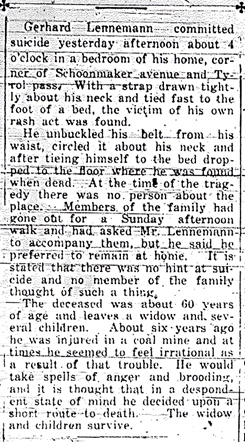
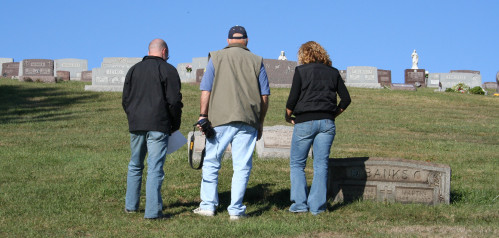
Several months later, I traveled to Monessen with my father, brother and sister for a family history trip (so much fun!). We went to the Monessen Public Library and spread out to start researching. I went right to the microfilm machines to search the newspapers and this is the front-page news that I found for 9 June 1918:

linneman1

linneman2Gerhard Lennemann committed suicide yesterday afternoon around 4 o’clock in a bedroom of his home, corner of Schoonmaker avenue and Tyler pass. With a strap drawn tightly about his neck and tied fast to the foot of a bed, the victim of his own rash act was found.  

He unbuckled his belt from his waist, circled it about his neck and after tieing himself to the bed dropped to the floor where he was found when dead. At the time of the tragedy there was no person about the place. Members of the family had gone out for a Sunday afternoon walk and had asked Mr. Lennemann to accompany them, but he said he preferred to remain at home. It is stated that there was no hint at suicide and no member of the family thought of such a thing. 

The deceased was about 60 years of age and leaves a widow and several children. About six years ago he was injured in a coal mine and at times he seemed to feel irrational as a result of that trouble. He would take spells of anger and brooding, and it is thought that in a despondent state of mind he decided upon a short route to death. The widow and children survive. [3]

This was not what we were expecting! I called my father over to read the headline – he was shocked. His grandmother had never mentioned her father, let alone his suicide.

The good news, genealogically speaking, was that I had discovered a date and cause of death. Yet I was left with so many questions. At this time in 1918, Gerhard was about 56 years old, and had four grown sons (three in the Monessen area) and a daughter Elizabeth (my father’s beloved grandmother). Elizabeth had just given birth to her second child only a month earlier and lived just a few blocks away.

linneman4

I was able to find a death certificate and coroner’s report for Gerhard “Lenemann,” as he was named in the newspaper article. The coroner’s report was witnessed by Chris and George Lenneman (his sons), and Mike Walko, [?] Laird and Lieut. Abright, with a “decision” of “Suicide by hanging.”[4] The death certificate confirmed the family’s address, his occupation of coal miner, cause of death as “Suiside by hanging to head of bed”, and his place of burial in Grandview Cemetery.[5]

DSC_0029

Gerhard Linneman arrived in the United States in 1903, followed by his wife and children in 1904.[6] I have not been able to locate Gerhard in the 1910 census in either Pennsylvania or West Virginia (where they may have also lived), nor found any coal mining records for him as of now. If he was injured 6 years before his death (around 1912), he most likely would not have been in Monessen, so more research is needed to see where the Linnemanns were before their arrival in Monessen (around 1915-1916).[7]

I’ve spent a lot of time thinking about Gerhard. Was his “anger and brooding” and “despondent state of mind” due to the coal mining accident? Or was there a mental health issue of depression or anxiety or something else? There are so many questions, and I will most likely never find those answers to these. This part of researching my family – wanting to know so much more about the actual person, their “whys” – can be agonizing.

And then there was the rest of the family … Gerhard’s widow, sons and daughter. One son was serving in World War I (when did he find out about his father?), and another would enlist in the next month.[8] His daughter had two young children (one was my grandmother). And his widow. The losses she had already endured before her husband’s suicide were numerous. I’ll save her story for another post. How did this family cope after Gerhard’s death? Was it expected? Did they visit his tombstone? Or were they embarrassed by the stigma of mental health issues? I can only imagine …

IMG_0061

Back to the research trip with my family … my father, shocked, had never heard anything from his family about Gerhard or his death. He never even knew that Gerhard had left Germany. Again, my father’s grandmother Elizabeth (Gerhard’s daughter) was the only grandparent that he knew — in fact, he had lived with her as a child in Pittsburgh, and later she with him New Jersey. In all of that time, she never once mentioned her father or his suicide. Was she still hurt and sad? Or embarrassed? Or had she just moved on, as so many of our ancestors were required to do to survive?

Some family events stay hidden and aren’t passed down to children and grandchildren. Until they are unearthed by a great-great-granddaughter almost 90 years later.

Have you found an ancestor with possible mental health issues?


SOURCES:

[1] “World Mental Health Day – 10 October,” World Health Organization (http://www.who.int/mental_health/world-mental-health-day/en/ : accessed 3 October 2018).

[2] “Local Notes” and “Card of Thanks,” Daily Independent (Monessen, PA), 13 June 1918, p. 1, col. 5; digital images, Ancestry.com (http://www.ancestry.com : accessed 29 September 2017).

[3] “Man Tied Belt Around Neck and Strangled Self While Family Is Absent,” Daily Independent (Monessen, PA), 9 June 1918, p. 1, col. 1; microfilm, Monessen Public Library, Monessen, PA.

[4] Westmoreland County, Pennsylvania, “Coroner Record Dockets,” database, Westmoreland County, Pennsylvania (http://www.co.estmoreland.pa.us : accessed 29 September 2017), entry for Gerhard Lenemann, no. 273, 9 June 1918.

[5] Pennsylvania Department of Health, death certificate 69108 (1918), Gerherd Lenemann; Bureau of Vital Statistics, New Castle.

[6] “Baltimore, Passenger Lists, 1820-1948 and 1954-1957,” digital image, Ancestry.com (http://www.ancestry.com : accessed 2 October 2018), manifest, S. S. Oldenburg, Bremen to Baltimore, arriving 18 December 1903, p. 10, line 8, Gerhart Linnemann; And manifest, S. S. Cassel, Bremen to Baltimore, arriving 31 August 1904, p. 11, line 2, Elisabeth Linnemann; citing National Archives microfilm publication T844, RG 85.

[7] “Woman Found Dead in Bed,” The Monessen Daily Independent (Monessen, PA), 30 July 1935, p. 1, col. 2; digital images, Ancestry.com (http://www.ancestry.com : accessed 29 September 2017).

[8] “Pennsylvania, Veterans Burial Cards, 1777-2012,” digital image, Ancestry.com (http://www.ancestry.com : accessed 2 October 2018), cards for “Gerhard Lineman” and “Charistian Linneman”; citing Pennsylvania Veterans Burial Cards, 1929-1990, Series 1, Pennsylvania Historical and Museum Commission, Harrisburg, Pennsylvania.

© 2018 LAURA CUBBAGE-DRAPER. ALL RIGHTS RESERVED.

Women’s Words Wednesday

So much of our history is recorded, remembered, and influenced by the views our male ancestors. But that was only part of our story, and I am fascinated by the words of our female ancestors. I am adding a new blogging category called Women’s Words Wednesday where I will post and reflect on these important words that I have found in my research, in whatever form they arise (letter, photo, document or record).

Below is a letter from Sara Logan to Charles Cubbage, my great-grandfather, about Sarah Cubbage, Charles’ sister. [1]

[unreadable along frayed top edge of letter]
Valencia
Dec. 16, 1902

Mr. Charles Cubbage,
Dear Friend –
Will write you a few lines this morning in place of your parents to tell you that Sarah had fallen yesterday evening and got seriously hurt. It was so very icy, and she had gone to the shed to feed the chickens and was lying there when they found her. Her head pains her awfully and her back hurts her too. The Dr was here again this morning and said there was little improvement on her
[unreadable along frayed top edge of letter]
be no change for 48 [?]
She just lies and seems to be sleeping and does not seem to notice any one. Charlie I think poor Sara is quite [unreadable] your Father and Mother are so worried but I know Charlie you will come out if you can and if you do not come out the [unreadable, possibly “next word you” ??] that Sara will be better and fully recovered again and a marked improvement from her present condition.

From,
Sara Logan

Sadly, Sarah Cubbage died on Christmas Day, ten days after her fall. She was 45 years old. I do not know if Charles ever traveled the 30 miles from Swissvale to Penn Township in Butler County to visit his sister before she died. At this time in 1902, only Sarah and her brother James L. were still living at home with their parents – their five brothers, including Charles, had all left Butler County.

But who was Sara Logan? And why did she write the letter “in place” of Charles’ parents, James and Barbara Cubbage? Sara mentioned how worried they were and that her brother should “come out if you can”. Were James and Barbara too distraught to write the letter? These are questions I most likely won’t know the answers to, but get me thinking about the role that women played during a tragedy.

Sarah Cubbage, who never married, worked for many years as a servant in the home of John R. Logan. I am fairly certain that Sara Logan was connected to this family – either a relative of John, or possibly the spouse of one of John’s sons. Sara Logan wanted Charles to travel to see his sister, yet she seemed to stay positive at the end of the letter, hoping that Sarah will be “better and fully recovered.”  What was it like for her to be the bearer of bad news? Did she reach out on her own, or at the request of the parents? And since Sarah Cubbage didn’t survive, did Sara Logan need to write another letter to  Charles, and possibly the other brothers, to let them know about her passing? Or did Sarah’s parents James and Barbara send a letter?

Sarah’s obituary reported that “her death was made harder to those who loved her best by her continued promise of recovery”[2] making it appear that she was improving before she died. It also mentioned that she had for many years “remained in the home of Mr. John R. Logan, deceased, and where she was loved and will be mourned deeply” suggesting a close relationship with the Logan family. The obituary also notes that her brothers in Montana and Washington were unable to attend the funeral, leading me to believe that Charles made the trip from Swissvale to Penn Township.

Sara Logan’s letter to Charles, as well as Sarah Cubbage’s obituary, were found tucked inside of the Cubbage Family Bible, originally owned by her parents, James and Barbara.[3] I’m thankful for Sara’s words that convey part of Sarah’s story.


SOURCES:

[1] Sara Logan (Valencia, Pennsylvania) to “Mr. Charles Cubbage”, letter, 16 December 1902. Privately held by the author.

[2] “In Memoriam,” undated clipping from unidentified newspaper, citing death of Sarah Cubbage on 25 December 1902 in Penn Township, Pennsylvania; privately held by the author.

[3] James and Barbara Cubbage Family Bible, The Holy Bible (New York: American Bible Society, 1870); privately held by the author.

© 2018 LAURA CUBBAGE-DRAPER. ALL RIGHTS RESERVED.