My Ancestors

Sentimental Sunday – Playing “Hearts” Through the Mail

Easter Sunday 1952
I love to play cards – poker, hearts, canasta … you name it. This is because I was raised by some serious card-playing Cubbages. Family favorites included hearts, poker and “aw $hit” (also known as “oh hell” or ”aw pshaw”). If there were Cubbages gathered together, there was always card game. I think of my grandfather – Art Cubbage, known to us as Pop-Pop – whenever we play. We even had an honorary game of “aw $hit” after Pop-Pop’s funeral.

My grandfather was an avid card player. I can remember being too young to play, but hearing the laughing, and occasionally yelling, when they played cards. As we kids got older, we learned the games and started playing with my parents and my grandfather. And I distinctly remember him getting frustrated at times with how we played (“I wonder what the hell that call means?”). These wonderful memories make me smile when I see my extended family and we get a game of hearts going after dinner.And when we play with my kids, I often tell them two of my favorite card-playing stories about Pop-Pop …

Story #1: Pop-Pop’s favorite card game was Hearts. And he was good. He played regularly with his friends Bob and Ralph. They would get together every year or so for a Hearts Tournament, where they would meet and play for the weekend. They had a flag with a heart on it, a medal for the weekend champion (who kept it until the next tournament), and some years even had matching shirts! It sounds like such a fun weekend away to me!

I have a few pictures from their card-playing adventures:
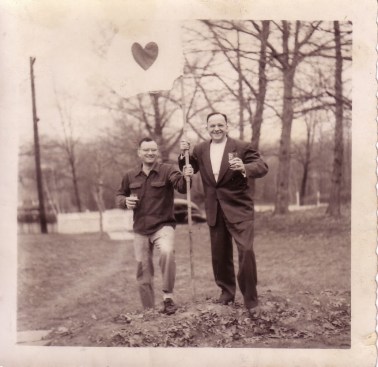
easter sunday 1952_0001
“Easter Sunday 1952”

Easter Sunday! This was when Pop-Pop was living in New Jersey and my grandmother and the boys were still in Pittsburgh. I wonder how he got away with that one!
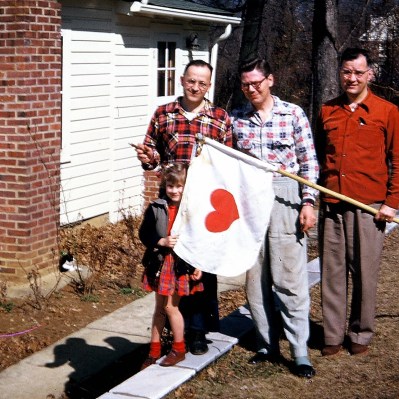
hearts tour april 1953 (1)
“Hearts Tour April 1953”


Hearts Tour April 1954
“Hearts Tour April 1954”
hearts tour 1958, zanesville, oh
“Hearts Tour 1958, Zanesville, OH”

Story #2: This is my favorite card-playing story about Pop-Pop and his buddies … and how much they loved playing cards. In between these tournaments they played cards by mail! Yep, good old snail mail – no online hearts like we can play today. It’s hard to imagine, and to explain, but here are the basics …

One of them would deal out the cards and mail them to the other two players (each person would get his 17-card hand, and I’m guessing that he held onto the “kitty” until the first hard). Then the person who was to the “left of the dealer” would mail his card that he “played” to the next player, who would add his card and mail both to the next. The dealer would mail the “trick” to the winner, who would then play a card to his “left” and so on. These games would last months. Those were some serious card players! In this day and age of instant gratification and immediate results, it’s hard to imagine a game going on for that long. But I can envision how excited they were when they received an envelope of cards in the mail!

In the 1960s and 1970s, my grandfather hosted a poker game in his cellar twice a month with some friends from his neighborhood in New Providence. This picture is probably from the mid-1960s. My grandfather is in the middle … with all of the poker chips! The young fellow to the left is my father, who was probably sitting in for one of the guys.

image 42

At some point in the mid-1970s, my Dad brought me and my sister along when he went to play one Friday night. And you can ask my sister … we still remember listening to their chatter in the cellar through the heating ducts from upstairs!

Fast forward another 20 years and the weekend card playing returned! This time Pop-Pop played “aw $hit” (notice the matching sweatshirts for the occasion!) near the Poconos with his sons Jeff and Corky, and his friend Willie.
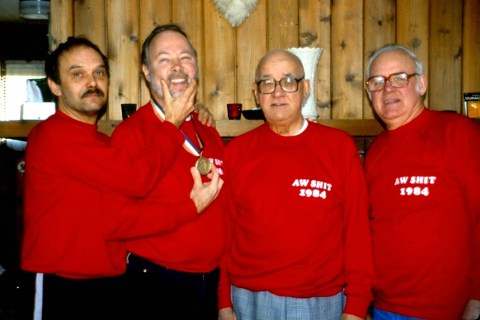
aw shit tourn. poconos

Both of my sons are good card players, and we enjoy playing a few hands over school breaks or with the rest of the Cubbage clan. This family tradition will be passed down to another generation of Cubbage descendants!

© 2019 LAURA CUBBAGE-DRAPER. ALL RIGHTS RESERVED.

Wedding Wednesday – Piecing Together Details About a Marriage

On Saturday, January 12th, it will be the wedding anniversary of my second great-grandparents, Charles Schwenk and Marian “Mary Ann” Burd. They were married in 1871 in Pittsburgh, Pennsylvania.

de93e-18712bswank2bburd2bmarriage2bcertificate

This photocopy of the marriage certificate is from a file of family records and images that my grandfather had with his pictures.[1]  I do not know who has the original image, but my father believes that several family heirlooms and records were photocopied in the 1970s and given to my grandfather by one of his sisters.

This certificate confirms the marriage that I found in a complied book of marriage returns from the City of Pittsburgh: Charles Schwenk, age 24, married Mary Ann “Bird,” age 21, on 12 January 1871 in a Civil Ceremony by Samuel McMasters, Ald.[2]  Both Charles and Mary Ann were from Saltsburgh, Allegheny County (a village in North Versailles Township).

While it’s fantastic to find documents and abstracts about our ancestors, there is so much more that I would love to know about Charles and Mary Ann.  I don’t have any pictures of them, or diaries or letters …  but what if I could know a little more about their wedding?

2b788-006

Charles was a Civil War Veteran who applied for an invalid pension. In the many, many incredible documents that were included in his Compiled Service and Pension records, there is an affidavit that Mary Ann submitted for her widow’s pension. She needed to prove that she was married to Charles. The affidavit was from Isaac and Martha Mason and dated 3 March 1899.[3]

That the soldier Charles G. Schwenk and Mary A Schwenk now a Widow were married on January the 12″ 1871 at Pittsburgh Pa. That said Mary A Schwenk was living with them at Saltsburg Pa at the time of her marriage to the soldier Charles G. Schwenk.
That after the return of the couple from Pittsburgh were the marriage took place, they had the wedding supper at their (Deponents House) and that they the Deponents participated at the wedding festivities held in honor of the said marriage.
That the said Mary A. Schwenk lived with them (Deponents) for about 2 years before her marriage to the soldier and know that she was not married prior to the marriage to the soldier above named.
That they know the facts testified to in this affidavit of their own Personal knowledge, having had an intimate aquaintence with Mary A Schwenk before and after her marriage to the soldier.

Wow! So now I know a little more about Charles and Mary Ann’s wedding. The wedding “supper” was held at the home of Isaac and Martha Mason in Saltsburgh, after they were married in the City of Pittsburgh. In the 1870 census, just a year before the wedding, Mary Ann was living with the Masons in North Versailles Township, and working as a domestic servant.[4]  Charles was also living in North Versailles in 1870 and was enumerated on the same day and only a few pages apart in the census book.[5]  Both were no longer living with their parents, and it appears that they met in Saltsburgh.

There is another interesting item in this affidavit that needs further research. One of the witnesses to this affidavit was Margaret Orris, who was Mary Ann’s sister. When Margaret Orris died in 1922, her obituary listed eight children including Mrs. Harry Mason.[6]  Harry Mason was the son of Isaac and Martha Mason, whom Mary Ann worked for and lived with in 1870. There seem to be some connections between the Burd, Orris and Mason families that need to be explored. Maybe that’s how Mary Ann found work with the Masons and ended up in Saltsburgh? Or maybe Mary Ann introduced Harry to her niece?

In the meantime, I’m happy to know a little more about the wedding of my second great-grandparents and how they celebrated this important event!

Have you found details about a wedding outside of a marriage record?


SOURCES:

1] Marriage Certificate, Charles Schwenk-Mary Ann Burd, 12 January 1871; photocopy privately held by the author’s father, ca. 1975.

[2] Western Pennsylvania Genealogy Society, compiler, Marriage Returns City of Pittsburgh, Allegheny County, PA, 1870-1875. Pittsburgh: Western Pennsylvania Genealogical Society, 1999.

[3] Affidavit of Isaac and Martha Mason, 3 March 1899, Mary Ann Schwenk, widow’s pension application no. 586124, certificate no. 475533, service of Charles G. Schwenk (1st Sgt., Co. C, 82nd reg., Pennsylvania Infantry, Civil War); Case Files of Approved Pension Applications …, 1861-1934; Civil War and Later Pension Files, Department of Veterans Affairs, Record Group 15, National Archives, Washington, D.C.

[4] 1870 U.S. census, Allegheny County, Pennsylvania, North Versailles, population schedule, McKeesport Post Office, p. 20 (penned), dwelling 137, family 137, Isaac Mason; digital image, Ancestry.com (http://www.ancestry.com : accessed 13 January 2014) citing National Archives publication M5393_1294; Family History Library Film 552793.

[5] 1870 U.S. census, Allegheny County, Pennsylvania, North Versailles, population schedule, McKeesport Post Office, p. 23 (penned), dwelling 156, family 156, John Rogers; digital image, Ancestry.com (http://www.ancestry.com : accessed 13 January 2014) citing National Archives publication M5393_1294; Family History Library Film 552793.

[6] “Former Creighton Woman Summoned by Death,” The Valley Daily News (Tarentum, PA), 17 February 1922; photocopy, Community Library of Allegheny, copied by library staff, 12 October 2012.

© 2019 LAURA CUBBAGE-DRAPER. ALL RIGHTS RESERVED.

Happy Birthday and Happy New Year!

Happy Birthday Pop-Pop! 


I love this picture of my grandfather, Art Cubbage, taken on New Year’s Eve 1959. This was probably taken at a neighbor’s house in New Providence, NJ. Art’s mother-in-law, Elizabeth Linneman Speck Merz is on the far left and I believe the other two women lived on the same street. My grandfather was born on December 31, 1912 in Swissvale, PA. Since his birthday was on New Year’s Eve, he always had a party!

Wishing you all a Happy New Year! May you find exciting new discoveries as you climb your family tree!

© 2018 LAURA CUBBAGE-DRAPER. ALL RIGHTS RESERVED.

Family Recipe Friday – Pierogi!

Family recipe Friday is a daily blogging prompt from GeneaBloggersTRIBE which encourages the family historian to share a family recipe, as suggested by Lynn Palermo of The Armchair Genealogist.

Food can be such a big part of our family history, culture and memories. Family recipes are often passed down to children and grandchildren, sometimes after been kept a secret. There may be family stories and traditions attached to these recipes, adding richness to our family narrative.

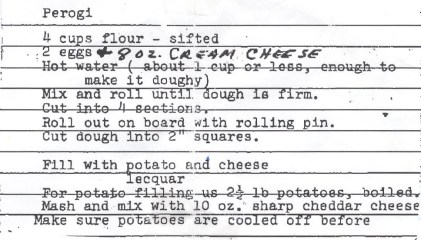
I come from a pretty German-inspired food tradition in my family. My husband’s traditions are much more Slovakian-influenced. Three of his four grandparents were born in Slovakia! At Christmastime, they always had pierogis on Christmas Eve – those yummy filled dumplings associated with Central and Eastern Europe.

The pierogi filling varies by region and country. My husband’s maternal grandmother filled her pierogis with farmer’s cheese. In the 1980s, my father-in-law took over making them, but he made them with potatoes and cheddar – my husband’s favorite!

003 (2)

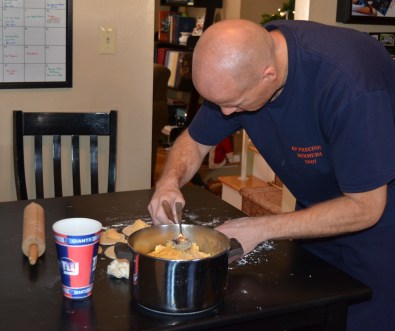
About 12 or 13 years ago (we can’t seem to remember which year), my husband took over the tradition of making pierogi for the family after both his father and grandmother had passed away. He makes his father’s recipe, with a cream cheese dough and a potato and cheddar filling. Every December, Hubby spends a day making around 8 dozen pierogi, and then freezes them until we are ready to cook them on Christmas Day.

dsc_8818.jpg

The first years were tough … the dough was too thin and broke easily, or was too thick to stay closed.  Sometimes the pierogis broke open when they were boiled. On Pierogi Making Day in those yearly years, I would take our young boys out for some Christmas shopping, as Hubby’s language got a little salty 😊.

dsc_8819.jpg

But practice makes perfect, and they are delicious! He’s figured out the mechanics of making the dough, found the perfect sized cup to cut out the circles (we can never get rid of that NY Giants cup!), and the filling is just the right mixture of potato and cheesiness.

Whatever we make on Christmas Day (usually a pork roast) feels like the side to the main dish – pierogis! Hubby boils them, and we have melted butter with onions on the table to put over them (except for my German family who puts gravy on them, and everything else!). If it’s possible, I think the leftovers are even better – we fry them up with the butter and onions, and add a little garlic salt. Yum!

This recipe, and its connection to past generations, is such an important part of our Christmas traditions. The next time you make a family recipe, jot down some memories of the meal, the holiday or the traditions. Or call you mom or grandma and ask about the recipe, then add this to your family history.

What is your favorite traditional holiday recipe?

© 2018 LAURA CUBBAGE-DRAPER. ALL RIGHTS RESERVED.
Women’s Words Wednesday – Oma’s Origin Story

So much of our history is recorded, remembered, and influenced by the views our male ancestors. But that’s only part of our story, and I am fascinated by the stories of our female ancestors. I have added a new blogging category called Women’s Words Wednesday where I will post and reflect on these important words that I have found in my research, in whatever form they arise (letter, photo, official document, etc.).

My Oma (“grandma” in German), Elise Gegenheimer, was born in 1919 in Ittersbach, Baden-Württemberg, Germany. Her mother, Louise Gegenheimer (age 22), was not marred and died from an infection contracted after childbirth, when her daughter was only 5 weeks old. I had heard bits and pieces of her story as a child: I knew that she was raised by a foster family, but that’s about it. Many years ago, my mother was preserving old family pictures and records and typed up Oma’s story:

002

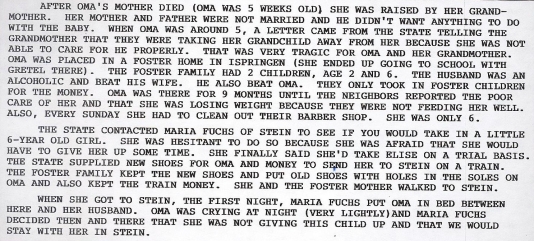
“After Oma’s mother died (Oma was 5 weeks old), she was raised by her grandmother. Her mother and father were not married and he didn’t want anything to do with the baby. When Oma was around 5, a letter came from the state telling the grandmother that they were taking her grandchild away from her because she was not able to care for her properly. That was very tragic for Oma and her grandmother. Oma was placed in a foster home in Ispringen (she ended up going to school with Gretel there). The foster family had 2 children, age 2 and 6. The husband was an alcoholic and beat his wife. He also beat Oma. They only took in foster children for the money. Oma was there for 9 months until the neighbors reported the poor care of her and that she was losing weight because they were not feeding her well. Also, every Sunday she had to clean out their barber shop. She was only 6.

            The state contacted Maria Fuchs of Stein to see if you would take in a little 6-year old girl. She was hesitant to do so because she was afraid that she would have to give her up some time. She finally said she’d take Elise on a trial basis. The state supplied new shoes for Oma and money to send her to Stein on a train. The foster family kept the new shoes and put old shoes with holes in the soles on Oma and also kept the train money. She and the foster mother walked to Stein.

            When she got to Stein, the first night, Maria Fuchs put Oma in bed between her and her husband. Oma was crying at night (very lightly) and Maria Fuchs decided then and there that she was not giving this child up and that she would stay with her in Stein.”

001
Louise Gegenhimer, age 19.

The story of my grandmother, as told by her daughter, is an important part of our family history. These words show the upheaval of changes in living situations, the dangerous and heartbreaking year with the foster family, and the eventual placement with Maria Fuchs. We are still connected with the Fuchs family in Germany. They were my grandmother’s family – and are our family today. And my mother still stays in touch with Oma’s biological mother’s family. I can’t imagine how hard this must have been for Oma’s grandmother, having lost her daughter, to then have to give up her granddaughter (I don’t know too much about the reason why they felt that she was unable to care for Oma).

Oma
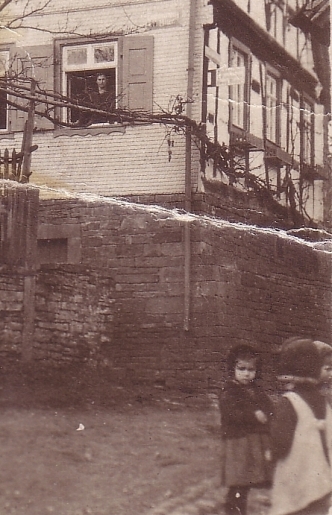
The only picture of my Oma as a child: around age 4 while still living with her grandmother in Ittersbach.


As hard as it is to read these words about my beloved Oma’s origin, I am thankful that I have a better understanding of where she came from. And I am so thankful for Maria Fuchs, and her willingness to say “yes” when asked to take in little Elise Gegenheimer. Because of her, Oma grew up healthy, married Adolf, had my mother, moved to America, and lived to be 91 years old.

19
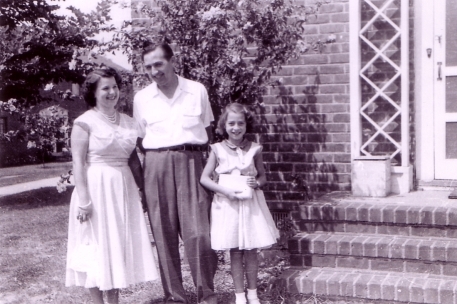
Oma, Opa, and my mother in Dumont, NJ, 1953.

© 2018 LAURA CUBBAGE-DRAPER. ALL RIGHTS RESERVED.